
By Suchi Shah
When Play Meets Purpose: Our FLN Mela Journey
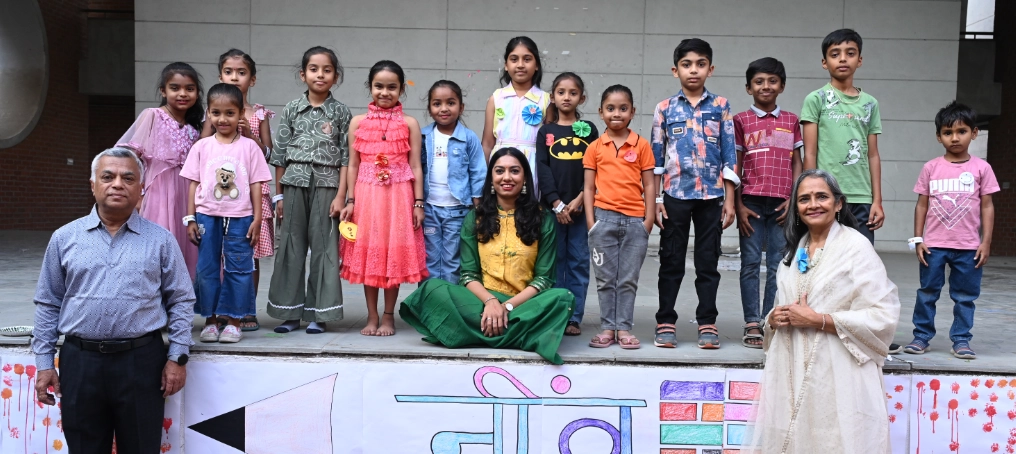
When we decided to host Adko Dadko, our Foundational Literacy and Numeracy (FLN) Mela, some people asked us a simple question: “Why not just call it a Bal Mela? Why not a fun fair?” The answer is equally simple. Because this was not just about fun. It was about foundations. Across India, the push for Foundational Literacy and Numeracy has gained momentum through initiatives like NIPUN Bharat Mission and the vision laid out in the National Education Policy 2020. These policies clearly state that every child must achieve basic reading, writing, and numeracy skills by Grade 3. But policy alone cannot transform learning. Communities must participate. Parents must understand. Teachers must feel supported. Children must experience learning differently. That is why we hosted Adko Dadko – Dhoom Dhadako, Akshar Paake Ank Paake.
A Bal Mela Celebrates Childhood. An FLN Mela Builds Capability. A Bal Mela is usually filled with rides, food stalls, games, and entertainment. It celebrates childhood joy—and that is beautiful and important. But an FLN Mela is designed with intention. Every game, every activity, every corner has a learning purpose.
At Adko Dadko, children were not just playing. They were:
- Building number sense through hands-on math games
- Strengthening phonemic awareness through interactive language activities
- Solving puzzles that required logical thinking
- Reading, counting, grouping, estimating, and expressing
It looked like fun. It sounded like laughter. But underneath it all, it was structured learning. And that is the difference.
Why Foundational Skills Matter in the 21st Century?
In the 21st century, literacy and numeracy are no longer just about reading a paragraph or solving sums on paper. They are survival skills. A child who cannot read fluently by age 8 struggles in every subject later. A child who lacks number sense finds math, science, and even daily life decisions overwhelming.
Neev Shikshan Sanstha is relentlessly working towards bringing about a paradigm shift in the way teachers and the teaching profession is perceived. We nurture and support teachers by conducting frequent workshops for them and being vocal of our appreciation of their contribution. We continuously inculcate in them the mindset to adopt democratic and not authoritative teaching practices to make learning an enjoyable experience rather than a fearful one . Our efforts shall be to give teaching an esteemed place as an employment option because teachers are the builders of the future and deserve all the respect and support that we can extend.
But beyond academic success, FLN builds:
- Critical thinking
- Problem-solving ability
- Confidence in communication
- Independence in learning
In a world driven by information, technology, and rapid change, foundational skills determine whether a child participates fully or remains on the margins.The global economy rewards those who can analyze, interpret, calculate, and communicate. Even basic financial decisions—understanding a bill, calculating change, reading instructions—require literacy and numeracy.
From Individual Effort to Collective Responsibility
One of the biggest myths about foundational learning is that it is the school’s job. It is not only theirs. A child spends a few hours in school. The rest of the time is at home and in the community. If parents believe learning only happens inside textbooks, progress slows down. If teachers feel isolated in their effort, burnout increases. If communities treat education as someone else’s responsibility, children fall through the cracks. Adko Dadko was designed to shift this mindset. When parents played number games alongside their children, they realized that learning does not require expensive materials. When teachers saw children engaging joyfully, they rediscovered the power of experiential pedagogy. When community members witnessed structured learning disguised as play, they understood that foundational skills can be strengthened anywhere. Collective action begins with shared understanding.
Joy and competition Can Coexist
There is a false binary in education: either learning is joyful or it is competitive. Adko Dadko proved that both can coexist. Children danced. They laughed. They competed. But they also:
- Counted accurately
- Formed words confidently
- Solved problems collaboratively
When rigor is embedded inside joy, retention improves. Confidence grows. Anxiety reduces. This is what 21st century classrooms must look like!
Making Learning Visible
Another reason we chose to host an FLN Mela instead of a generic fun fair was visibility. Foundational learning gaps are often invisible. A child may sit quietly in class, appearing attentive, yet struggle to decode simple words. Another may memorize procedures without understanding quantities. An FLN Mela brings these skills into the open—safely and positively. Through games and stations, children demonstrate what they know and where they need support. Teachers gather insights. Parents observe strengths and gaps without fear or stigma. Learning becomes transparent. Support becomes targeted.
A Name with Purpose
“Adko Dadko” may sound playful—and it is. The rhythm reflects childhood energy. But the tagline “Akshar Paake, Ank Paake” reminds us of the real goal: mastering letters and numbers. Names matter. Language shapes perception. If we had called it just a Bal Mela, the focus would have shifted to entertainment. By calling it an FLN Mela, we anchored the purpose firmly in foundational learning.
Looking Ahead
Hosting Adko Dadko was not a one-day event. It was a statement. It said:
- Foundational skills are urgent.
- Learning must be a collective effort & community-owned.
- Joyful pedagogy is powerful.
- Every child deserves strong start!
In the 21st century, nations are built not just by infrastructure or technology, but by human capability. And human capability begins with the ability to read, write, and reason with numbers. That is why we hosted an FLN Mela. Not just a fun fair. Not just a celebration. But a collective commitment to strong foundations.