
By Kavita Shah
Children’s School Readiness post the implementation of Engage–Enable–Empower Programme: Findings and field reflections from Anganwadis in Vadodara Urban District
What does it really mean to be ready for school?
School Chale Hum. The phrase brings back memories of the early-2000s Sarva Shiksha Abhiyan campaign, with children running towards school. But a child being ready to go to school is only one part of readiness. The deeper question is whether a child is ready to learn, participate, express, explore and grow.
Children spend about three years in Anganwadis before entering formal schooling at around six years of age. What happens during these early years matters. It shapes not only foundational academic skills, but also the curiosity, confidence, communication and social abilities that children carry into school.
What does it really mean to be ready for school?
School readiness is not a checklist of what a child can count, name or recognize. It is about the whole child — and about creating environments in which children can think, imagine, question, express, collaborate and discover.
Three years of building readiness
Neev Shikshan Sanstha’s Engage–Enable–Empower (3E) Programme was implemented over three years across Vadodara Urban district. The programme drew on the National Framework for Early Childhood Education and the Early Learner Assessment (ELA) Framework developed by Azim Premji University. School-readiness indicators were contextualized across five developmental domains: Language, Cognitive, Socio-emotional Learning (SEL), Physical and Creative.

The programme combined teacher training with on-field support. More than 900 Anganwadi Teachers were trained in areas including Oral Language and Early Numeracy, Brain Development, Classroom Culture, Free Play and the development of Teaching and Learning Materials (TLMs). Classroom-level best practices were documented and shared, with the training approach grounded in adult learning principles.
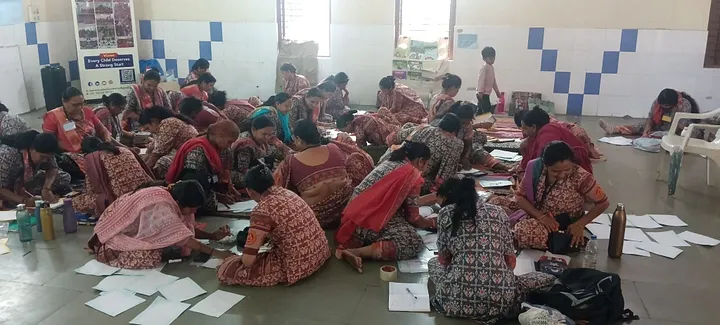
Anganwadi Teachers engaged in a hands-on learning activity during a Neev workshop.
Training does not end in the workshop
A training room can introduce a new idea. A classroom is where that idea has to become practice. For this reason, NEEV’s support continued beyond workshops through classroom demonstrations, observations, feedback and coaching.
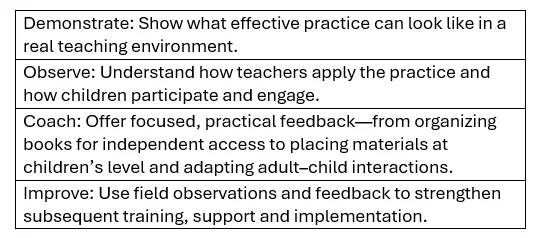
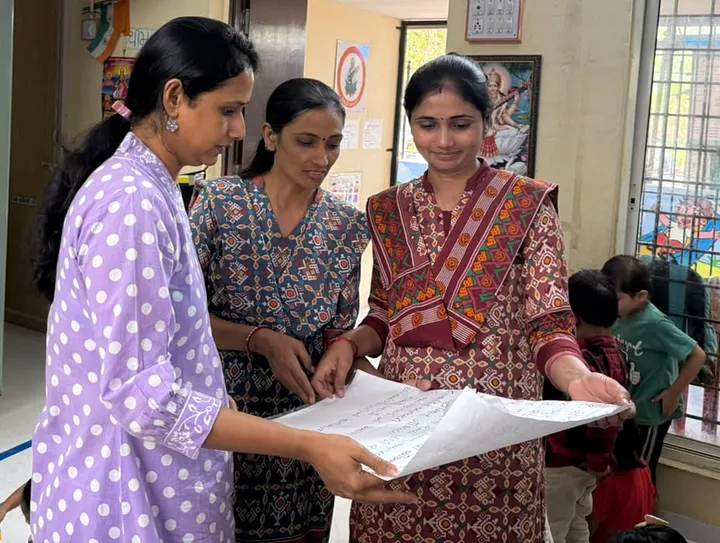
Field-level observation and coaching helped translate training into classroom practice.
Training does not end in the workshop
The 3E Programme extended beyond teacher training. On the ground, the team worked with teachers and communities to create environments where children could learn through play, exploration and everyday participation.
1) Learning through play: Toy Libraries
Toy Libraries created accessible spaces where children could learn, explore and express themselves through play. Age-appropriate toys, games and puzzles supported cognitive, motor, creative, social and emotional development while actively reducing screen time. The libraries also offered parents and caregivers simple ways to engage children in meaningful learning through play while strengthening community connections.
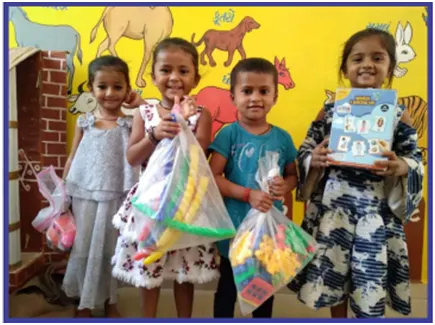
Children issuing learning resources from the Toy Library
2) Learning through exploration: Four Learning Corners
NEEV established four learning corners each, in 90 Anganwadis — Dolls and Dramatics Corner, Puzzle and Block Corner, Creative and Arts Corner, and Reading and Storybooks Corner. These spaces were designed to support children’s cognitive, language, creative and socio-emotional development through unstructured activities and free play.
Their value lay not simply in putting materials into a room, but in how teachers brought those materials into everyday classroom routines. Regular monitoring and active teacher engagement helped ensure that the learning corners became part of children’s daily experiences.
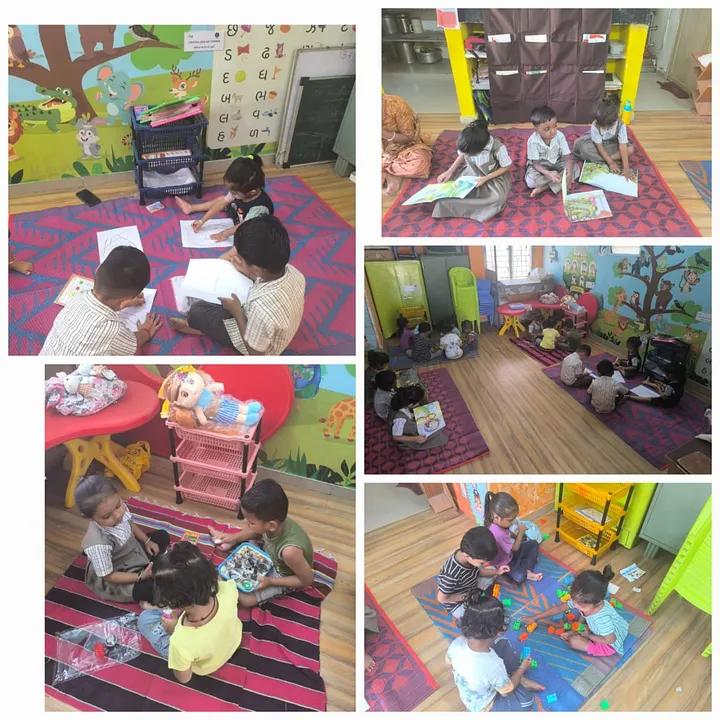
Children engrossed in activities across different learning corners
Success Story: A teacher who did not wait for resources
At Karodiya 7 Anganwadi, Kaushalya Ben saw the potential of a creative learning environment. When her centre lacked basic resources to set up a Reading and Storybooks Corner, she did not wait for someone else to solve the problem. She mobilized parents to make reading pouches from old clothes and fertilizer bags. What began as a simple, low-cost idea brought parents into the learning process and inspired other centres to adopt the practice.
3) Making participation visible: the Attendance Board
The Attendance Board was a simple, low-cost initiative introduced to encourage regular attendance and make children’s participation active in nature. Its influence extended beyond the individual classroom: the initiative was recognized at the state level and subsequently replicated across Anganwadis. A small yet meaningful change — children now lead by marking their own attendance. which builds confidence, responsibility, and ownership in learning.
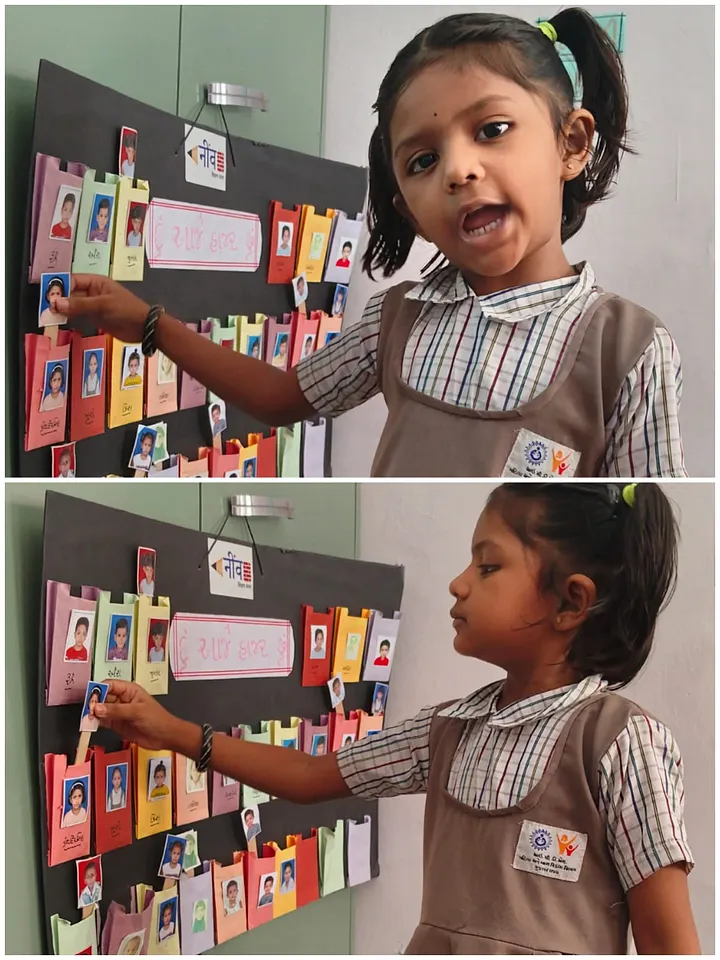
This builds children’s classroom bond, supports early learning, and can be easily used in any Anganwadi.
A broader idea of School Readiness
The School Readiness Programme moves beyond the traditional understanding of readiness as a checklist of language and mathematical skills. It recognizes that readiness is equally rooted in curiosity, confidence, communication, creativity, problem-solving, social connection, self-regulation and the ability to engage with the world around us.
Through meaningful play, exploration and interaction, children are not simply preparing to learn — they are already learning. The aim is to help children enter formal schooling as engaged, confident and curious learners, ready not only to perform, but to participate, explore and thrive.
So, are children ready?
At the end of the three-year programme, NEEV undertook an assessment to understand children’s school readiness. A sample of 200 children was assessed using a school-readiness assessment tool comprising 24 indicators across the five developmental domains. Anganwadis were randomly selected across Vadodara Urban’s four zones, while children within selected Anganwadis were selected based on availability on the assessment day.
A note on interpreting the findings
The assessment provides a picture of the readiness of the children who were assessed at the end of the programme. Because the assessment was post-programme and the selection of children within Anganwadis was convenience-based, the findings should not be interpreted as a causal estimate of programme impact.
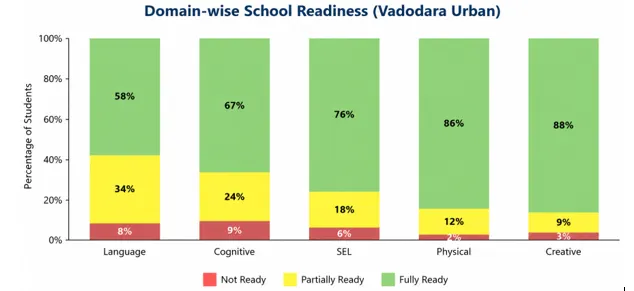
Readiness across the five developmental domains.
The domain-wise findings are especially instructive. Creative readiness was highest at 88%, followed by Physical at 86%, SEL at 76%, Cognitive at 67% and Language at 58%. The pattern points both to areas of encouraging readiness and to areas where further support is needed — particularly language.
Children closest to school entry
Of the 200 children assessed, 170 were 5–6 years old — the children who would be entering the formal school system in the current academic year. Among this group, 82% were classified as fully ready for school.
82% of the nearly-six-year-old children assessed were classified as fully ready
This group is particularly relevant because these children were at the point of transition into formal schooling.
What did the zones tell us?
Vadodara Urban is divided programmatically into four zones: East, West, North and South. The assessment showed variation across zones: East recorded 88% fully ready, West 84%, North 80% and South 56%. This variation reinforces the need to look beyond an overall programme figure and understand where additional support may be required.
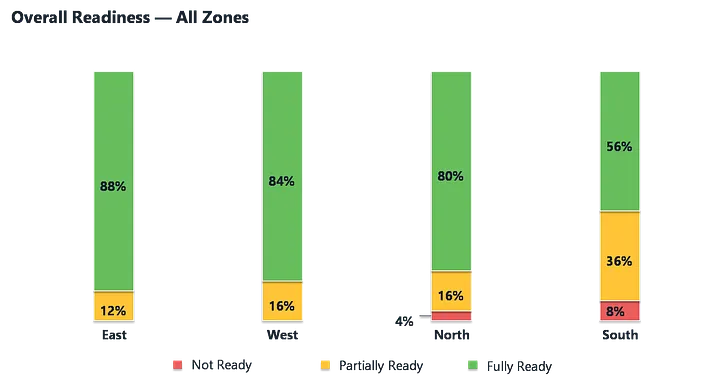
Overall readiness across Vadodara Urban’s four programme zones
Where do children need more support?
Across the 24 indicators, the assessment identified ten indicators where children showed comparatively lower readiness. These included specific aspects of language, problem-solving, sorting, creative expression and other developmental skills.
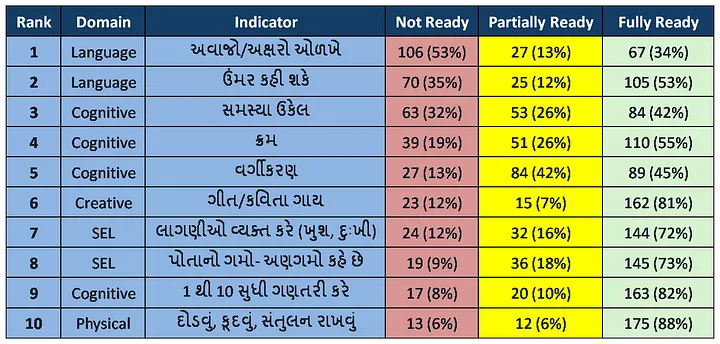
The ten indicators with comparatively lower readiness in the assessment
The detailed indicator-level findings are useful not as a scorecard, but as a guide for the next phase of programme improvement. They help the team identify where classroom practice, teacher support and curriculum alignment can be strengthened.
What the assessment taught us
The assessment was also a learning process for the programme team. Three lessons stand out:
- Data quality matters: Consistent data entry and careful assessment processes are essential for trustworthy findings. The team identified inconsistencies in data entry and the need to ensure that assessment tools are used only with the age group for which they were designed.
- Programme and assessment must align: Some assessment indicators did not fully align with the timing or expectations of the state curriculum. For example, the curriculum’s treatment of letter-sound reproduction and sorting differed from the assessment requirements. Future training and assessment planning will address these gaps.
- Good assessment needs well-prepared assessors: The programme team had in-depth familiarity with the assessment tool. The experience highlighted the importance of thorough preparation when interns or volunteers are involved in data collection, or of planning timelines that allow programme members to collect the data themselves.
The work continues
The end of the three-year programme is not the end of the learning. The assessment and field experience give NEEV a clearer understanding of what children need, what teachers can do with the right support, and where the programme itself must improve.

NEEV plans to establish more Learning Corners in Anganwadis, strengthen the alignment of training modules, delivery and fieldwork with the readiness indicators, and carry these learnings into work in Vadodara Rural and Anand District. The goal is clear: to help more children enter formal schooling with the confidence, curiosity and foundational capabilities they need to participate, learn and thrive.
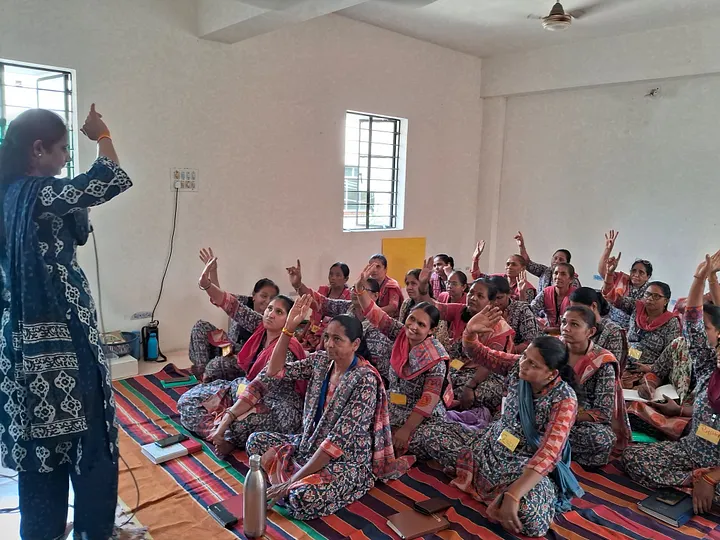
Teacher engagement is at the heart of creating responsive early-learning environments
With gratitude
This work has been strengthened by the continued support of the Pre-school Education Instructors (PSEIs), whose field-level monitoring and quality checks helped sustain implementation, and by the Program Officer (ICDS, Vadodara) for entrusting NEEV with this project. We are grateful to our mentors — Professor Jigisha Shastri (Azim Premji University), the Faculty of Human Development and Family Studies (Maharaja Sayajirao University of Baroda), and Dr. Manjiri Nimbkar (Pragat Shikshan Sanstha) — for their guidance and wisdom. We also thank Spectrum Impact, our patrons, for their continued support in enabling this work.
Help us build more spaces where children are ready not just to enter school, but to thrive in it.
Support NEEV’s work in early childhood education and school readiness.